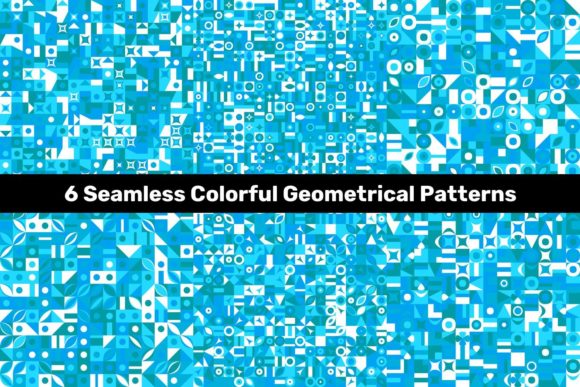
6 Seamless Blue Geometrical Patterns
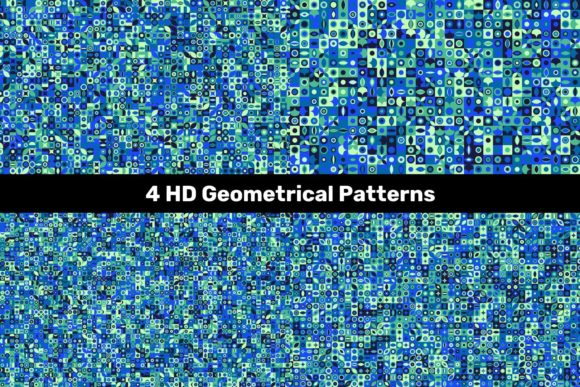
These six patterns are more than just blue backgrounds—they’re precision-crafted, infinitely tileable designs built for real-world use. Each one repeats flawlessly edge-to-edge, whether scaled across a 4K monitor, printed on fabric, or layered into a mobile app UI. The package includes six high-resolution JPG files (5000×5000 pixels), plus editable vector versions in both .EPS and .AI formats—so you get flexibility without compromise.
Why “seamless” matters—and why “blue” is just the beginning
“Seamless” means no visible joins, no awkward repeats, no pixelated edges when zoomed or stretched. That’s essential whether you’re designing packaging that wraps around a bottle, building a website background that adapts to any screen width, or printing textiles where misaligned tiles would ruin the final product. The blue palette isn’t limiting—it’s versatile. Deep navy grounds digital dashboards. Sky-blue tones soften educational slides. Teal-infused geometrics add energy to social media banners. And because all files are vectors, you can recolor any pattern instantly in Illustrator or Affinity Designer—no need to wait for custom edits.
For designers & marketers: Speed meets polish
If you juggle client revisions, tight deadlines, and brand consistency, this set saves time *and* elevates output. Need a clean, modern backdrop for an email campaign? Drop in one of the JPGs at full resolution—no resizing, no tiling glitches. Launching a new product line with a cohesive visual language? Use the .AI files to adjust stroke weight, spacing, or color to match your brand guidelines—then export crisp SVGs for web or PNGs for presentations. Unlike free pattern generators, these were crafted by a designer who tested each repeat across multiple scales and contexts. You won’t discover alignment issues after uploading to Shopify or Squarespace.
For educators & presenters: Clarity without distraction
Classroom slides, workshop handouts, and lecture visuals benefit from subtle structure—not noise. These patterns offer rhythm and order without competing with text or data. A light hexagonal grid in soft cerulean helps organize bullet points visually; a bold triangular motif in indigo adds quiet authority to title slides. Because the JPGs are 5000×5000, they scale cleanly even on large venue projectors. And since the vectors are layered and named logically (e.g., “background,” “overlay,” “accent”), swapping elements during lesson prep takes seconds—not hours.
For small business owners & freelancers: One-time investment, many uses
You don’t need a design degree—or a retainer for a graphic designer—to build recognizable, professional materials. A café owner can use one pattern as a repeating background on Instagram Stories announcing weekend specials. A freelance writer might apply another as a textured header in a client proposal PDF. A handmade jewelry seller can print one onto tissue paper inserts or use it as a subtle watermark behind product photos. With both raster and vector files included, you’re covered whether you’re editing in Canva (JPG), Photoshop (JPG + layer-friendly sizing), or Illustrator (full editability).
For hobbyists & makers: Playful, not punishing
If you’ve ever tried stitching a geometric quilt or laser-cutting acrylic coasters, you know how frustrating misaligned repeats can be. These patterns eliminate guesswork: import the .EPS into LightBurn or Inkscape, set your material dimensions, and tile automatically—the geometry stays sharp at any size. Want to mix two patterns? Overlay a low-opacity triangle grid over a dot matrix in GIMP or Photopea—both JPGs are resolution-matched and color-profile consistent. No tutorials required. Just drag, adjust, and make.
What beginners notice first—and what experienced users rely on
Beginners often gravitate toward the JPGs: open, place, done. It’s immediate. There’s no learning curve, no software compatibility worry. That’s intentional. But as skills grow, the vectors become indispensable. The .AI files include grouped layers, non-destructive effects, and editable swatches—meaning you can change the entire palette with one click, then export dozens of variations for A/B testing landing pages. Experienced users also appreciate the absence of embedded fonts or linked assets—everything is self-contained and portable across devices and teams.
Quality you can verify—not just trust
Each pattern was tested across three criteria: scalability (does it hold up at 200% zoom in Illustrator?), tiling behavior (does it align perfectly when duplicated in Photoshop’s offset filter?), and real-world output (was it printed on matte paper, vinyl, and cotton fabric to check color fidelity and edge continuity?). The answer is yes—across all six. No placeholder textures. No AI-generated ambiguity. Just clean, intentional geometry rooted in proportion, balance, and repetition.
When this fits—and when it might not
This set shines if your work involves repetition, branding, presentation, or physical production. It’s ideal if you value having options—JPG for speed, vectors for control—without paying for separate licenses or subscriptions. It’s less suited if you need animated patterns, photorealistic textures, or highly niche motifs like Islamic tilework or Art Deco sunbursts. It’s also not a substitute for custom illustration—but it *is* a reliable foundation you can adapt, reinterpret, and build upon.
- Need fast, print-ready backdrops? Use the JPGs—they’re optimized for CMYK-safe blues and RGB clarity.
- Building a design system? Import the .AI files to extract base shapes, build icons, or generate new variants.
- Teaching visual literacy? Project one pattern and ask students to identify symmetry, tessellation, or negative space.
- Prototyping UI components? Apply a subtle pattern as a card background in Figma using the JPG—then swap in a vector version later for developer handoff.
Whether you’re sketching ideas on a napkin or prepping files for a commercial printer, these six patterns meet you where you are. They don’t assume expertise—but they don’t limit it either. Blue is the starting point. Geometry is the structure. Seamlessness is the promise. And versatility? That’s built in.