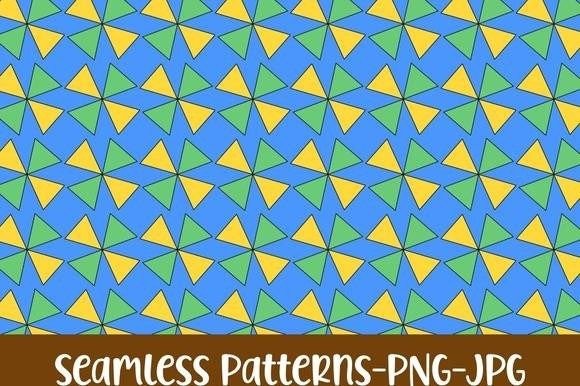
Triangle Seamless Repeat Patterns Background
A Triangle Seamless Repeat Patterns Background is a digital design asset composed of triangular motifs arranged to tile infinitely without visible seams or breaks. Created as vector artwork—typically in Adobe Illustrator—it repeats smoothly across any surface, making it ideal for textiles, wall coverings, packaging, web backgrounds, and print projects. The version described here delivers a 4,000 × 4,000 px artboard with both high-resolution raster outputs (JPG and PNG at 300 DPI) and scalable vector files, ensuring flexibility across media.
Why Consider a Triangle Seamless Repeat Patterns Background?
Designers, crafters, and small-business owners often seek repeat patterns that balance visual interest with technical reliability. Triangular geometry offers distinct advantages: it introduces dynamic angles and rhythm without the rigidity of squares or the softness of circles. This makes a Triangle Seamless Repeat Patterns Background especially useful when aiming for modern, structured, or geometric aesthetics—think minimalist branding, contemporary fabric collections, or architectural surface treatments.
Interest may also stem from practical needs: scalability, print readiness, or compatibility with design workflows. Because this asset ships as an Illustrator vector file, users retain full editability—colors, stroke weights, and spacing can be adjusted without quality loss. The inclusion of a transparent PNG supports layering in digital composites, while the JPG provides a universally compatible preview or fallback.
Key Benefits and Realistic Tradeoffs
Benefits include:
- Seamless tiling: Tested and constructed to repeat cleanly, reducing manual alignment work in layout software.
- Resolution versatility: Vector format scales to any size; raster files meet professional print standards (300 DPI at 4,000 px).
- Workflow integration: Compatible with Adobe Creative Cloud, Affinity Designer, and many web-based editors via SVG conversion.
- Transparency support: The included PNG allows non-destructive overlay on photos, gradients, or colored backgrounds.
Tradeoffs to acknowledge:
- Geometric specificity: Triangle-based layouts emphasize angularity—this may not suit organic, hand-drawn, or curvilinear design systems.
- Color and density limitations: As a single-pattern file, it doesn’t include alternate colorways or density variants. Users needing multiple versions must modify the source vector themselves.
- No licensing guidance included: While usable for personal and commercial projects in most cases, users should verify the seller’s license terms—especially for resale of physical products like apparel or stationery.
When This Background Fits Well
A Triangle Seamless Repeat Patterns Background is a strong fit in several scenarios:
- Print-on-demand product design: When creating fabric, wrapping paper, or notebook covers where consistent tiling and sharp edges matter, the 300 DPI raster files meet platform upload requirements, and the vector ensures future edits.
- Branding and identity systems: For designers building cohesive visual language—especially in tech, architecture, or education sectors—triangular repetition conveys precision and forward motion.
- Digital interface elements: Web or app backgrounds benefit from the transparent PNG, allowing subtle texture over dynamic content without obscuring legibility.
- Educational or experimental use: Students learning pattern construction or vector tiling workflows gain hands-on exposure to industry-standard artboard sizing and export practices.
When Alternatives May Be More Appropriate
This background is less suited for projects requiring:
- Non-geometric or illustrative styles: If your project calls for floral motifs, watercolor textures, or irregular hand-drawn repeats, a triangle-based vector won’t match the desired tone.
- Multilayered or animated patterns: This is a static, single-layer repeat. It lacks built-in opacity variations, blend modes, or frame-by-frame sequences needed for advanced motion or depth effects.
- Extensive customization out of the box: Unlike pattern bundles offering dozens of color variants or scale options, this is a single-file download. Users expecting plug-and-play variety will need to invest time editing the vector.
- Specialized substrates: For large-format printing (e.g., murals or vehicle wraps), some producers prefer native EPS or PDF/X-4 formats—not always included with standard Illustrator downloads.
Making an Informed Decision
To determine whether this Triangle Seamless Repeat Patterns Background aligns with your goals, ask these questions:
- What’s the primary output medium? If you’re printing at high resolution or scaling significantly, the vector + 300 DPI raster combination meets that need. For screen-only use at small sizes, even a lower-resolution PNG might suffice—and this file exceeds those requirements.
- Do you have access to vector-editing tools? While the PNG and JPG are immediately usable, full control over colors, spacing, and composition requires Illustrator or equivalent. If you lack that access—or prefer drag-and-drop simplicity—pre-rendered alternatives in varied sizes may save time.
- How much design consistency does your project require? Seamless tiling reduces visual interruption across surfaces. If your application involves repeated panels (e.g., fabric yardage or tiled web sections), this asset eliminates guesswork in alignment.
- Is scalability a long-term concern? Vector files preserve fidelity regardless of output size. If you anticipate reusing the pattern across business cards, billboards, or embroidery digitizing, the Illustrator source adds lasting value.
Finally, consider your timeline and skill level. Modifying vectors demands familiarity with path operations, swatch libraries, and pattern editing modes in Illustrator. If you’re new to these tools, allocate time for practice—or look for tutorials specific to seamless triangle tiling before committing.
Conclusion
A Triangle Seamless Repeat Patterns Background serves a defined but valuable niche: designers who prioritize clean geometry, reliable tiling, and cross-media adaptability. Its strength lies not in broad stylistic appeal, but in technical execution—vector precision, calibrated resolution, and intentional transparency. It is neither a universal solution nor a shortcut, but a purpose-built tool. Evaluating it alongside your specific output requirements, software access, and design objectives helps ensure it supports—not complicates—your workflow.