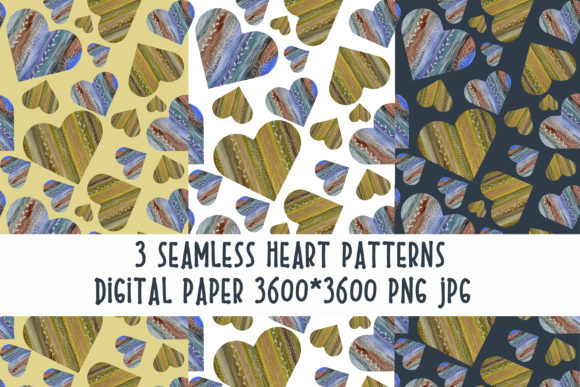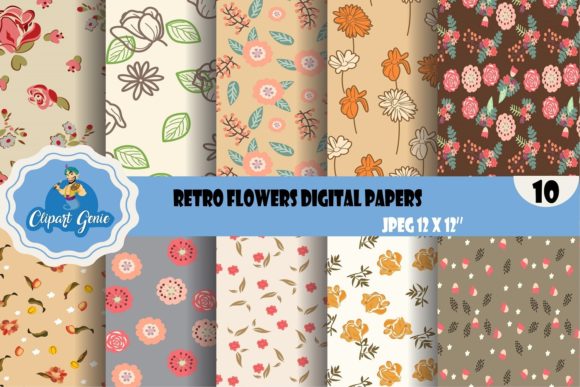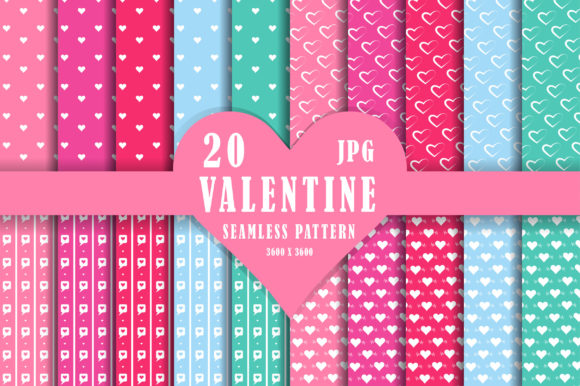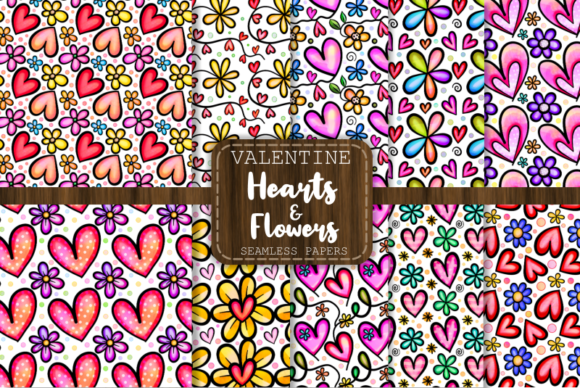
Hearts and Flowers Seamless Patterns
Hearts and Flowers Seamless Patterns is a curated digital design resource consisting of 12 high-resolution, hand-drawn seamless pattern files. Each pattern combines floral motifs and heart shapes rendered in watercolor ink—featuring soft edges, subtle texture, and organic variation in tone and saturation. The set delivers all files as JPGs at 300 DPI and 6000 × 6000 pixels, optimized for print and scalable digital use.
What This Set Offers—and What It Doesn’t
The collection emphasizes visual cohesion and tactile authenticity. The doodle-style linework and watercolor effects suggest a handmade aesthetic, making the patterns suitable for projects where warmth, approachability, or gentle romanticism matters. Because each file is a true seamless repeat, users can tile them across surfaces without visible seams—ideal for backgrounds, wrapping paper, fabric mockups, or web design elements.
What’s included is straightforward: 12 distinct JPG files, no source vectors, no layered PSDs, and no editable color variants. There are no SVGs, no transparent PNGs, and no alternate colorways or seasonal adaptations. The focus remains on the core set—floral + heart compositions—with consistent stylistic treatment across all pieces.
Who Might Benefit Most
Designers working on greeting cards, stationery, wedding invitations, or boutique packaging often seek patterns that convey sincerity and charm without appearing overly commercial. Hearts and Flowers Seamless Patterns fits this need when the project calls for a soft, artisanal sensibility—especially where watercolor texture adds dimension without overwhelming typography or illustration.
Print-on-demand creators may find value here for sublimation-ready backgrounds on mugs, tote bags, or journals. Because the files are large (6000 × 6000 px), they scale well to full-bleed product mockups and maintain clarity even when cropped or resized moderately. Crafters using design software like Adobe Photoshop, Affinity Designer, or Canva Pro can import and apply these patterns directly as fills or overlays.
Educators or students exploring pattern design fundamentals may also use this set as reference material—observing how repetition, motif density, and negative space interact in a cohesive, hand-influenced style.
Key Considerations Before Choosing
Resolution and format matter for intended use. At 300 DPI and 6000 × 6000 pixels, the files support professional printing up to roughly 20 × 20 inches at native size. However, users requiring larger-scale output—such as wall murals or billboard graphics—may need to evaluate whether interpolation or tiling strategies meet their quality threshold.
The watercolor aesthetic introduces intentional variability: pigment bleed, uneven washes, and slight opacity shifts. That’s an asset for naturalism but a limitation if strict color consistency or sharp geometric precision is required. For branding projects demanding exact Pantone matches or crisp vector scalability, these JPGs won’t substitute for editable vector assets.
Licensing terms aren’t specified in the prompt, but typical usage rights for such pattern sets allow both personal and commercial application—provided the files remain unmodified as standalone patterns. Reselling the JPGs as-is, or claiming authorship of the original artwork, would generally fall outside standard licenses. Users should verify permissions with the vendor before deploying in client work or mass-produced goods.
When Alternatives May Be More Appropriate
If your workflow relies heavily on vector-based editing—adjusting individual petals, recoloring hearts independently, or isolating motifs for cut files—then a vector-based floral-heart pattern pack would offer greater flexibility. Similarly, designers needing transparency (e.g., for overlaying patterns onto photos) will need to convert these JPGs manually or seek PNG versions elsewhere.
For projects emphasizing cultural specificity, botanical accuracy, or modern minimalism, other pattern libraries may align more closely. A set focused on Japanese cherry blossoms, Scandinavian linocut florals, or monoline geometric hearts would serve different expressive goals—even if the core theme (hearts + flowers) overlaps.
Users prioritizing accessibility should also consider contrast and legibility. While the watercolor effect adds depth, it can reduce contrast between foreground motifs and background washes. If text will sit directly over the pattern, testing readability at various sizes and weights is advisable.
Practical Evaluation Tips
Before integrating Hearts and Flowers Seamless Patterns into a project, ask:
- Does the watercolor texture support—or compete with—the rest of the composition? Try placing sample text or icons over a tiled preview to assess visual hierarchy.
- Is resolution sufficient for the largest intended output? Calculate maximum printable dimensions: 6000 px ÷ 300 DPI = 20 inches. For larger formats, confirm whether tiling multiple instances maintains acceptable seamlessness.
- How much post-processing flexibility do you need? If adjusting hue, saturation, or lightness non-destructively is essential, consider whether your software supports adjustment layers over JPGs—or whether converting to smart objects preserves editability.
- Does the stylistic consistency across all 12 patterns match your project’s tone? Review thumbnails side-by-side. Some may lean more floral, others more heart-dominant; ensure the balance suits your message.
Final Thoughts for Decision-Making
Hearts and Flowers Seamless Patterns serves a specific niche: designers seeking ready-to-use, hand-inflected repeats that communicate tenderness and organic charm. Its strength lies in execution—not breadth. The 12 patterns avoid redundancy while preserving a unified voice, making it efficient for projects with tight timelines or limited design resources.
It is not a universal solution. It does not replace custom illustration, nor does it offer the adaptability of parametric design tools. But for those evaluating pattern sets for a particular emotional register—gentle, heartfelt, quietly celebratory—it provides a focused, technically sound option.
Ultimately, alignment depends less on what the set contains and more on how its constraints and qualities intersect with your practical requirements: output medium, editing needs, stylistic intent, and licensing scope. When those factors converge, Hearts and Flowers Seamless Patterns becomes a functional, aesthetically coherent tool—not just decoration, but a considered design decision.