Valentine Hearts Seamless Patterns: Creative Fuel for Real Projects
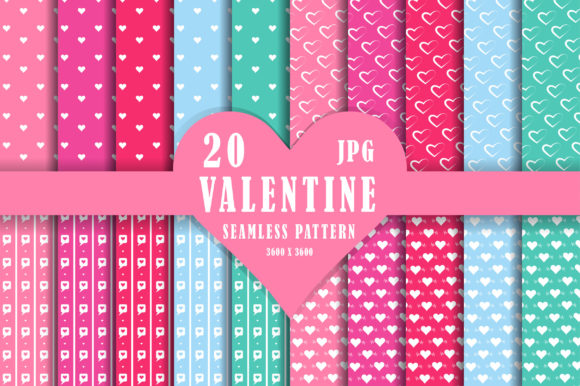
If you've ever stared at a blank design canvas before Valentine’s Day—wondering how to make invitations feel special, give your online shop a seasonal lift, or add warmth to handmade cards—you’re not alone. Valentine Hearts Seamless Patterns isn’t just another clipart pack. It’s a ready-to-use toolkit of 20 distinct, thoughtfully crafted digital paper designs—each built to tile perfectly, scale beautifully, and adapt seamlessly across physical and digital mediums.
What Makes These Patterns Actually Useful (Not Just Pretty)?
“Seamless” isn’t marketing jargon here—it means no visible repeats, no awkward edges, and no tedious manual tiling. Each of the 20 patterns is engineered to flow endlessly in any direction. That translates directly to time saved and consistency gained—whether you're printing 50 wedding invites or building a Shopify banner that stretches across desktop and mobile.
You’ll receive every pattern in two versatile formats: high-resolution JPGs (ideal for quick drag-and-drop into Canva, Photoshop, or Cricut Design Space) and vector-based EPS files (perfect for scaling to billboard size or editing individual heart shapes in Illustrator). All are sized at 12″ × 12″ (3600 × 3600 pixels) and rendered at 300 dpi—so they hold crisp detail whether printed on luxe cardstock or displayed full-screen on a boutique website.
For Small Business Owners & Crafters
Imagine updating your Etsy shop’s banner with a subtle, romantic texture—not loud or cliché, but quietly evocative. A soft watercolor heart pattern adds warmth without overwhelming your product photos. Or picture lining the inside of custom soap boxes with a delicate dot-and-heart motif: it feels intentional, cohesive, and handcrafted—even though it took seconds to apply.
Bottle cap magnets? Wedding favor tags? Laser-cut jewelry backings? These patterns hold up beautifully at small scales. One designer used the chalk-textured heart set to create reusable “love note” stickers for a local café’s February promotion—printed on matte vinyl, die-cut, and stuck to ceramic mugs. No bleeding, no pixelation, just charm that lasts.
For Digital Creators & Web Designers
Backgrounds matter more than we admit. A website’s hero section with a barely-there Valentine Hearts Seamless Pattern (say, faint gold foil hearts on ivory) conveys theme and tone instantly—without needing text. It works especially well for seasonal landing pages, email headers, or social media templates where brand consistency meets timely relevance.
Because each pattern is delivered at print-ready resolution, you can confidently use them as CSS background images (with background-repeat: repeat) or export as SVG-ready assets via the EPS files. No more stretching low-res PNGs or wrestling with tile alignment in Figma.
For Educators, Event Planners & DIY Hosts
A teacher making classroom valentines might layer a playful polka-dot heart pattern behind student names—then print on pastel cardstock for instant cohesion. An event planner designing place cards for a Galentine’s brunch could use a minimalist line-art heart pattern as a subtle border, then overlay elegant calligraphy. Even parents crafting a “Countdown to Valentine’s Day” poster for kids find these patterns helpful: one mom printed six variations on cardstock, cut them into puzzle pieces, and turned daily reveals into a tactile ritual.
Real Choices You’ll Make—And Why They Matter
Not all heart patterns serve the same purpose. Before diving in, consider your context:
- Tone match matters. A bold, graphic black-and-red geometric heart pattern energizes a T-shirt design—but might feel too sharp for a baby shower invitation. Soft watercolor or vintage-inspired textures often bridge emotional warmth and visual elegance.
- Contrast is practical. If you plan to overlay text or photos, test readability early. Light-on-light (e.g., pale pink hearts on cream) looks sophisticated—but only if your font color has enough contrast. The EPS files let you easily adjust base colors in vector editors if needed.
- Scale changes impact. A tightly spaced tiny heart motif reads as texture from afar but becomes busy up close—great for wallpaper, less ideal for business card backs. Meanwhile, a generously spaced outline heart pattern stays legible even when shrunk to 1.5″ square on a magnet.
Who Benefits Most—and How They Use It Differently
A freelance stationery designer might license one pattern as part of a full branding suite—using the EPS file to recolor hearts to match a client’s Pantone palette, then exporting variations for letterpress, foil stamping, and web use. A hobbyist making personalized ornaments may simply open the JPG in PicMonkey, drop in a photo, and print onto shrink plastic—no software expertise required.
Even non-designers get value. One customer—a nurse who runs a side gig making resin coasters—used the marble-textured heart pattern as a printed base layer under her epoxy pours. The result? Coasters that look like luxury goods, not craft-store experiments. Another sewist printed a scaled-down version onto iron-on transfer paper and applied it to cotton tea towels—creating limited-edition kitchen gifts in under an hour.
What These Patterns Don’t Do (And Why That’s Okay)
They won’t auto-generate your entire invitation suite. They won’t choose fonts or write copy for you. And they aren’t animated, interactive, or embedded with metadata. But that’s by design. Their strength lies in being foundational—not prescriptive. They give you texture, rhythm, and mood, so you can focus on what only you bring to the table: voice, story, and personal connection.
Also worth noting: because these are digital papers—not clipart or isolated icons—they’re optimized for coverage, not cropping. Trying to extract a single heart shape from the JPGs will yield pixelated results. For standalone elements, the EPS files are your friend—or better yet, pair these patterns with a simple heart icon set for layered compositions.
Getting Started Without Overthinking It
You don’t need to use all 20 at once. Start with one that matches your immediate need: the gauzy linen-textured hearts for elegant stationery, the retro halftone version for playful T-shirts, or the metallic foil style for luxe packaging. Preview them at actual size on screen first—zoom in to check repeat integrity, then open one in your usual tool and test how it behaves with your fonts, photos, or cutting settings.
Remember: great design often lives in restraint. A single well-chosen Valentine Hearts Seamless Pattern—applied thoughtfully—can elevate more than a dozen rushed alternatives. It’s not about filling space. It’s about giving your project a quiet, confident heartbeat.