Mardi Gras Leopard Print Patterns: A Practical Design Asset for Seasonal and Brand Projects
Design assets that balance thematic specificity with broad usability are rare—especially when tied to culturally rich, time-bound celebrations like Mardi Gras. The Mardi Gras Leopard Print Patterns set stands out not because it’s flashy, but because it resolves a common creative bottleneck: finding high-fidelity, on-brand pattern resources that work across both digital and print applications without requiring extensive customization.
What This Set Actually Delivers
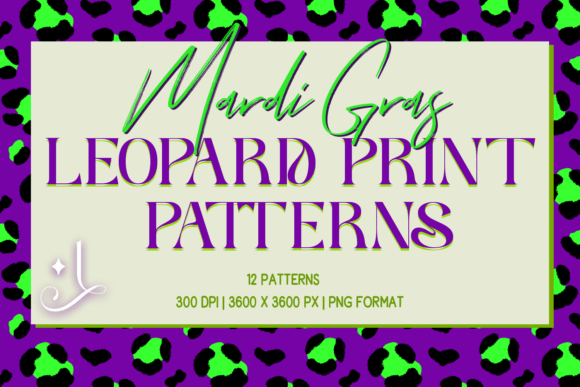
This is a curated collection of 12 distinct patterns—not variations of a single motif, but intentionally differentiated designs that share core visual DNA: bold leopard-inspired rosettes layered with Mardi Gras color cues (deep purples, emerald greens, royal golds, and occasional accents of crimson or black). Each file is delivered at 3600 × 3600 pixels, 300 DPI, in PNG format with transparent backgrounds. That resolution supports sharp output up to ~12 × 12 inches at print resolution—a practical sweet spot for greeting cards, gift tags, small-batch packaging, and book covers.
The transparency is non-negotiable for real-world use. It allows designers to overlay patterns onto colored substrates, adjust opacity, or blend with gradients—critical when adapting to brand palettes or seasonal product lines. Unlike JPEG-based pattern sets, there’s no white halo or compression artifacting around edges, which matters when scaling or layering in tools like Adobe Illustrator, Affinity Designer, or even Canva Pro.
Where These Patterns Perform Best
Professionals who regularly produce physical deliverables will find immediate utility here. Consider:
- Small-batch stationery creators: Using one pattern as a background for foil-stamped invitations, another as a repeat for belly bands on carnival-themed gift boxes.
- Educators and community organizers: Applying the motifs to printable classroom banners, event signage, or student-made parade props—without licensing concerns tied to commercial clip art.
- DIY product makers: Scaling a pattern to fit a 20-ounce tumbler wrap, then reusing the same asset for matching sticker sheets or digital social media templates.
- Bloggers and content creators: Incorporating subtle repeats into Pinterest pins or blog headers to reinforce seasonal editorial themes without overwhelming readability.
What makes the Mardi Gras Leopard Print Patterns set more versatile than generic leopard prints is its intentional restraint. The rosettes avoid hyper-realism—they’re stylized enough to read clearly at small scales (e.g., 0.25-inch repeats on fabric labels) yet retain enough detail to hold interest at larger sizes (e.g., full-page backgrounds in digital planners).
Quality and Consistency Across the Set
All 12 patterns maintain consistent line weight, spacing rhythm, and color saturation. There’s no jarring shift from watercolor-textured to vector-perfect or from dense coverage to sparse scatter—common inconsistencies in bundled design assets. This uniformity means users can mix and match within a single project (e.g., using Pattern #3 for a card front and Pattern #7 for the envelope liner) without visual dissonance.
The 300 DPI resolution holds up under typical workflows: resizing down for web use introduces no pixelation; scaling up slightly for large-format printing (e.g., 18 × 24-inch posters) remains serviceable if not pushed beyond 150% enlargement. For true large-scale applications like wall decals or fabric yardage, users would need to verify tile alignment manually—but given the seamless repeat structure built into each file, this is rarely an issue.
Realistic Limitations to Acknowledge
No pattern set is universally optimal. The Mardi Gras Leopard Print Patterns excels in contexts where Mardi Gras aesthetics align with audience expectations—but that also defines its boundary. It’s not suited for minimalist branding, corporate annual reports, or medical or financial communications where thematic exuberance could undermine tone.
Similarly, while the color palette nods to tradition, it doesn’t include pastel or monochrome variants. Users needing grayscale-compatible versions—or CMYK-optimized separations for offset printing—will need to convert files themselves. The PNG format, while ideal for flexibility, doesn’t embed ICC profiles, so color fidelity depends on the user’s monitor calibration and export settings.
Also worth noting: these are *patterns*, not standalone illustrations. They don’t include isolated rosette elements, borders, or coordinating icons. If a project requires modular components (e.g., mixing leopard motifs with fleur-de-lis silhouettes), additional asset sourcing or custom illustration would be necessary.
Audience Fit: Who Benefits Most—and Why
The strongest return comes for creators operating at the intersection of craft, commerce, and calendar-driven demand. Think Etsy shop owners launching limited-edition Mardi Gras collections in January, local bakery marketers designing cupcake wrapper graphics, or school PTA teams producing fundraiser materials. These users value speed, reliability, and legal clarity—all supported by this set’s straightforward licensing and technical execution.
Freelancers working across multiple clients also benefit. Having a vetted, high-res pattern library reduces time spent sourcing, editing, or troubleshooting low-quality downloads. One designer reported cutting 2–3 hours per seasonal campaign by using the Mardi Gras Leopard Print Patterns as a base layer—then adjusting hue/saturation to match client brand guidelines rather than building from scratch.
For educators or nonprofit staff, the value lies in reproducibility: once downloaded, the files require no subscription, internet access, or attribution when used internally. That matters for schools with limited tech budgets or volunteer-run organizations managing tight timelines.
Integration Into Existing Workflows
These patterns integrate cleanly into standard design pipelines. In Adobe Creative Cloud apps, they function as swatches or linked smart objects. In Canva, uploading as PNGs preserves transparency and allows cropping, masking, and blending modes. Even in free-tier tools like Photopea, the resolution and format behave predictably.
A practical tip: rename files descriptively before importing (e.g., “MG-Leo-PurpleGold-Dense” instead of “Pattern_07.png”). That saves time when scanning thumbnails mid-project—and avoids accidental duplication across folders.
For long-term use, store the original ZIP archive separately from working files. Re-downloading isn’t always possible, and having a clean master copy prevents version drift when applying global adjustments like brightness correction or color profile conversion.
Final Assessment
The Mardi Gras Leopard Print Patterns set succeeds by meeting a narrow need with precision—rather than trying to be everything to everyone. Its strength isn’t novelty, but execution: reliable resolution, thoughtful color application, consistent styling, and format choices aligned with how professionals actually work. It won’t replace custom illustration for flagship branding, but it reliably fills gaps where speed, legality, and visual cohesion matter most.
If your projects regularly intersect with festive, community-oriented, or seasonal themes—and you’ve ever delayed finalizing a layout waiting for a usable pattern resource—this set delivers tangible workflow efficiency. It’s the kind of asset that disappears into your process until it’s missing: suddenly, you notice how much smoother things run when the fundamentals just work.