Ufo Seamless Patterns: Cosmic Design Meets Practical Versatility
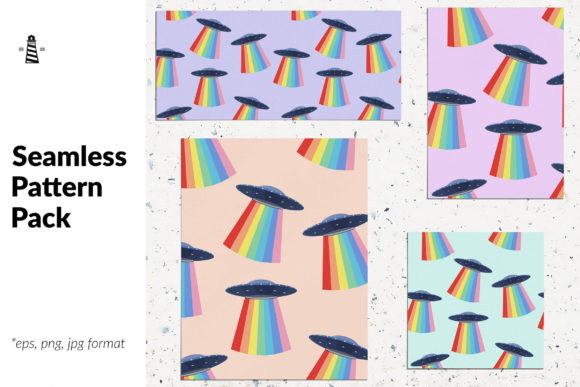
Ufo Seamless Patterns represent a distinctive intersection of imaginative space-themed illustration and rigorous technical execution. Unlike mass-produced digital repeats or algorithmically generated motifs, these patterns are carefully hand-drawn—each line, curve, and orbital path shaped with intention. The collection features 100 original vector artworks, all unified by a cohesive celestial aesthetic: sleek extraterrestrial craft, subtle starfields, gravitational swirls, crystalline constellations, and softly glowing nebulae—all rendered without visual seams. This isn’t just “space wallpaper.” It’s a precision-crafted design system built for real-world application across physical and digital media.
What Makes These Patterns Truly Seamless—and Why That Matters
Seamless patterns must align perfectly at their edges so that when tiled, no discontinuity interrupts the visual flow. With Ufo Seamless Patterns, seamlessness isn’t an afterthought—it’s foundational. Each design undergoes manual edge-matching: artists adjust anchor points, refine Bezier curves, and test tile behavior across multiple iterations. The result? No visible borders, no misaligned gradients, no jarring repetitions—even at large scale. This level of control is essential for applications where continuity affects both aesthetics and function: imagine wrapping a 10-foot mural around a curved retail wall, printing a continuous roll of gift wrap, or tiling a responsive web background across ultra-wide monitors. A single pixel mismatch can fracture immersion; these patterns eliminate that risk entirely.
Hand-Drawn Detail in a Vector World
In an era dominated by AI-generated assets and procedural textures, the value of human craftsmanship stands out. Every UFO silhouette in this collection was drawn with deliberate weight variation—thicker hull contours suggesting structural integrity, thinner antennae implying delicate instrumentation. Orbital paths follow true elliptical geometry, not approximated circles. Star clusters avoid uniform spacing; instead, they echo natural stellar distribution, with denser groupings near “galactic cores” and sparse outliers drifting into void-like negative space. Because these are vector-based, that hand-drawn nuance scales infinitely: zoom in on a 12-inch print at 300 dpi and still see crisp, intentional linework—not blurry raster artifacts.
File Flexibility Designed for Real Workflows
The delivery set reflects deep understanding of professional production pipelines:
- 8 EPS files: Industry-standard for legacy print workflows, especially with older RIP (Raster Image Processor) systems used in commercial textile mills and large-format printers.
- 8 AI files: Fully editable Adobe Illustrator documents—layers preserved, swatches named, symbols organized—so designers can recolor, isolate elements, or adapt motifs without reverse-engineering.
- 2 transparent PNGs (12×12 inches, 300 dpi): Optimized for digital mockups—think website hero sections, app UI overlays, or presentation slides where clean layering over photos or videos is required.
- 8 high-res JPGs (12×12 inches, 300 dpi): Ready for immediate use in CMS platforms, email templates, or client previews—no vector software needed.
This multi-format approach respects how different users operate. A textile designer might start in Illustrator to adjust repeat spacing for a specific fabric weave; a web developer may drop the PNG directly into CSS background declarations; an educator preparing astronomy-themed classroom materials could insert the JPG into a Google Slides deck without conversion delays.
Textiles: From Concept to Woven Reality
Ufo Seamless Patterns translate exceptionally well to fabric. Their moderate motif density—neither overly busy nor sparse—ensures clarity at common textile scales: 24–48 inch repeat widths suit scarves and apparel, while tighter 12-inch repeats work for quilting cotton or upholstery. The vector foundation allows precise scaling to match thread count requirements: a 200-thread-count sateen bedsheet benefits from smoothed gradients and softened edges (easily achieved via Illustrator’s raster effects), while a coarse canvas tote gains impact from bold, simplified silhouettes extracted from the same source file. Designers report successful dye-sublimation runs on polyester performance wear—where the subtle glow effects in certain patterns remain legible even after heat transfer.
Wallpapers and Architectural Surfaces
Large-scale interior applications demand patterns that hold visual interest at both arm’s length and across a 20-foot wall. These space-themed designs succeed because they layer spatial depth: foreground UFOs sit crisply atop mid-ground orbit rings, which in turn float above soft-focus background nebulae. When printed on non-woven wallpaper, the tonal range reproduces faithfully—deep indigos retain richness, pale gold accents stay luminous, and transparency layers (in the PNG variants) allow for custom underprinting of metallic foils or UV gloss highlights. One architecture firm used a modified version of Pattern #7—rotated 15 degrees and scaled to 36-inch repeat—to create a dynamic, non-directional field on a curved lobby wall, avoiding the “striped” effect common with linear repeats.
Web and Digital Interfaces
For digital use, seamless patterns offer subtle branding continuity without overwhelming content. A fintech startup integrated Pattern #3 as a low-opacity (opacity: 0.08) CSS background on dashboard cards—its gentle orbital motion implies data flow and systemic connection, reinforcing brand messaging about interconnected financial ecosystems. Because the pattern is vector-derived, it loads instantly (unlike large raster backgrounds) and responds fluidly across devices. Designers also use individual UFO elements—extracted from the AI files—as animated SVG icons: a hovering craft pulses gently on hover states, synced to micro-interaction timing functions.
Greeting Cards, Invitations, and Print-on-Demand
The emotional resonance of space themes—wonder, curiosity, possibility—makes these patterns ideal for celebratory contexts. A wedding invitation suite used Pattern #12 inverted (dark background, light motifs) with foil-stamped UFO outlines, evoking night-sky romance. Birth announcements featured a scaled-down version of Pattern #5 embedded in watercolor-style digital letterpress textures—showcasing how vector art can hybridize elegantly with organic media simulations. For print-on-demand creators, the 12×12 inch, 300 dpi JPGs integrate seamlessly into platforms like Printful or Gelato: no resizing errors, no DPI warnings, no color profile mismatches—just predictable, gallery-ready output.
Educational and Research Applications
Beyond aesthetics, these patterns serve pedagogical functions. Astronomy educators use them as visual anchors in lessons on orbital mechanics—the elliptical paths mirror Kepler’s laws; relative sizing between craft and celestial bodies introduces scale modeling concepts. One university physics department adapted Pattern #9 into an interactive SVG, where students could drag sliders to adjust eccentricity and observe real-time changes in orbital shape—a tactile complement to equations. Researchers studying visual perception have cited the controlled contrast ratios and deliberate negative-space distribution in these patterns as useful stimuli for experiments on pattern recognition thresholds.
Considerations for Optimal Use
While versatile, thoughtful implementation ensures best results:
- Color mode awareness: The AI and EPS files are RGB-native but embed CMYK profiles for print prep. Always convert to CMYK *after* final edits if targeting offset litho—especially for deep blues and violets, which shift noticeably without proper profiling.
- Scale context matters: A pattern optimized for 12-inch repeats may feel cramped on a 60-inch-tall mural. Test tile behavior at intended output size—some users duplicate and merge adjacent tiles in Illustrator to preview larger repeat units before committing to production.
- Transparency nuance: The two included PNGs use alpha channels, not matte layers. When overlaying on non-white backgrounds, ensure your platform honors alpha blending—older email clients may flatten transparency, requiring fallback solid-background versions.
- Licensing clarity: These are licensed for commercial use—including resale on physical products—but prohibit redistribution of raw source files. Modifying and embedding into derivative works (e.g., a themed font family or NFT collection) is permitted under standard terms.
Why “Space Theme” Endures Beyond Trend
Space-themed design persists—not as nostalgia, but as functional metaphor. In branding, it signals innovation, exploration, and forward-thinking. In education, it provides accessible entry points to complex scientific ideas. In wellness contexts, cosmic imagery supports mindfulness practices through vastness and perspective-shifting. Ufo Seamless Patterns avoid cliché by rejecting retro-futurism tropes (chrome fins, ray guns) in favor of quiet, observational realism: softly diffused light sources, plausible propulsion glows, and compositions that imply motion without speed lines. This restraint makes them adaptable across industries—from pediatric oncology waiting rooms (calming, non-threatening cosmic visuals) to quantum computing startups (abstract yet grounded representations of invisible forces).
Integration Without Friction
What sets this collection apart isn’t just artistic merit—it’s operational fluency. A product designer prototyping smart-home packaging imported Pattern #4 directly into Figma via SVG import, then applied CSS filters to simulate matte vs. glossy finishes. A ceramicist used the EPS files to generate CNC-cut stencils for sgraffito decoration on moon-phase dinnerware. A game studio licensed three patterns as tileable environment assets for a zero-gravity puzzle game—scaling them procedurally based on player proximity. Each use case leverages the same core assets, yet the outcomes diverge meaningfully because the foundation supports adaptation, not just replication.
Ufo Seamless Patterns bridge imagination and execution. They invite interpretation—whether as literal spacecraft, abstract energy signatures, or metaphors for connection across distance—while delivering technical reliability expected in professional creative workflows. Their strength lies not in spectacle alone, but in sustained usability: the kind that survives from initial sketch to final kiln firing, from browser viewport to billboard hoarding, from classroom whiteboard to peer-reviewed visualization.