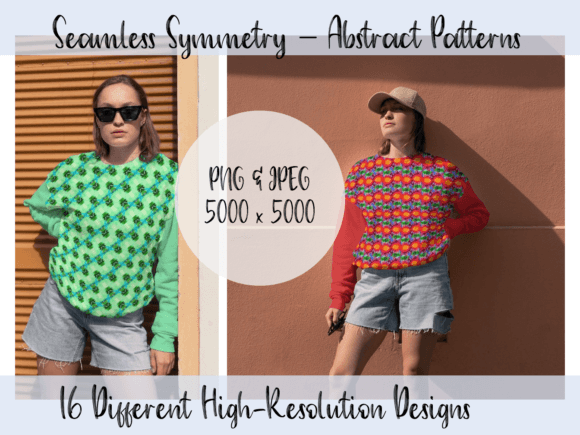
Seamless Symmetry – Abstract Patterns: Where Precision Meets Creative Flexibility
At the intersection of mathematical elegance and visual artistry lies a quietly powerful design resource: Seamless Symmetry – Abstract Patterns. These aren’t merely decorative motifs—they’re rigorously engineered digital assets built on principles of translational repetition, rotational balance, and reflective harmony. Each of the 16 high-resolution designs in this collection operates as a self-contained visual unit: when tiled, edges align invisibly, eliminating seams, gaps, or visual stutter. This technical precision transforms them from static images into versatile, scalable systems—ready to adapt across physical and digital surfaces without distortion or compromise.
Why Resolution and Format Matter—Beyond Aesthetic Appeal
The inclusion of both PNG and JPEG files at 5000 × 5000 pixels is not arbitrary—it reflects deliberate functional foresight. That resolution supports sharp reproduction at large physical scales: a full-bleed tote bag print, a wall mural spanning three meters, or a luxury packaging wrap with fine-detail embossing registration. The PNG format preserves transparency, enabling effortless layering over photographs, gradients, or textured substrates—essential for branding mockups or editorial layouts. JPEGs offer broad compatibility and optimized file size for web use, especially where bandwidth or CMS constraints apply.
Crucially, the uniform dimension (square aspect ratio) grants compositional neutrality. Designers aren’t forced into landscape-or-portrait compromises. Whether scaling down for a business card background or up for a festival stage backdrop, the symmetry remains intact—not stretched, cropped, or skewed. This consistency reduces pre-production friction: no need to manually adjust tile spacing, rotate elements to “hide” joins, or rebuild patterns for different outputs.
Real-World Applications Across Diverse Domains
What makes Seamless Symmetry – Abstract Patterns resonate across such varied contexts is their dual nature: they carry quiet sophistication without prescriptive meaning. Unlike illustrative or typographic assets, they don’t compete with content—they support it. Consider how this plays out across sectors:
- Branding & Identity Systems: A fashion label launching a capsule collection might use one of the bolder geometric variants as a subtle underlay in lookbook spreads—visible only in negative space or foil-stamped onto recycled paper stock. The pattern reinforces cohesion without dominating product photography.
- Educational Materials: Mathematics educators have integrated these patterns into lessons on tessellation, group theory, or crystallography. Students can import the files into vector editors, isolate unit cells, rotate or mirror sections, and observe how symmetry operations generate infinite planes—a tactile bridge between abstract theory and visual proof.
- Product Development: Independent makers designing laptop sleeves or notebook covers benefit from predictable repeat behavior. A single 5000 × 5000 file maps cleanly onto standard sleeve dimensions (e.g., 38 × 27 cm), with excess resolution absorbed during print RIP processing—no interpolation artifacts, no pixelation at seam lines.
- Digital Experiences: Web designers use lighter, lower-contrast variants as subtle animated backgrounds—applying CSS
background-size: 200%;andanimation: pan 20s linear infinite;to create slow, hypnotic drift. Because the tile repeats flawlessly, motion feels organic, not mechanical.
Material Translation: From Screen to Substance
One of the most overlooked strengths of this collection is its cross-material fidelity. Many abstract patterns fail when translated from RGB screen to CMYK print—or worse, onto textured surfaces like canvas, kraft paper, or woven cotton. These designs were conceived with output variance in mind. Their mid-tone density range (avoiding extreme blacks or washed-out near-whites) ensures reliable ink coverage on uncoated stocks. Their balanced contrast holds detail in both digital embroidery previews and silk-screened textile applications.
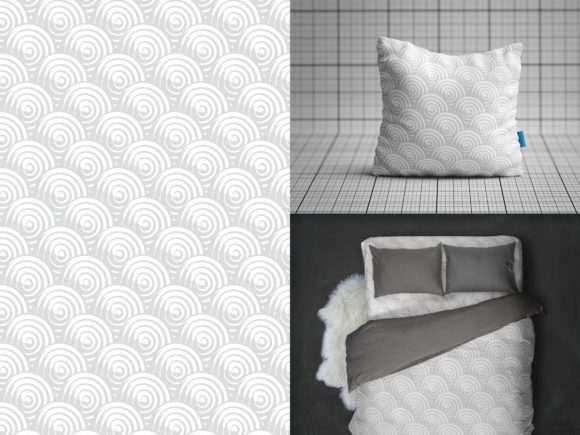
Take shopping bags as an example: a matte-finish recycled bag printed with a soft tonal wave pattern (one of the 16 variants) gains tactile depth—the ink sits slightly raised, catching light differently across folds and handles. Conversely, the same pattern on a glossy iPad cover reflects ambient light with crisp edge definition. Neither application requires recoloring, rescaling, or re-rasterization. The source file serves both—preserving creative intent across touchpoints.
User-Centered Workflow Integration
For creators working across tools—Adobe Creative Cloud, Affinity Suite, Figma, Canva, or open-source alternatives—these files integrate without friction. In Figma, for instance, designers set the image as a fill, then adjust Repeat Grid spacing to match the native 5000 px unit. In Photoshop, using Edit > Define Pattern creates a swatch usable across brushes, fills, and layer effects. Even non-designers—small-business owners building Mailchimp campaigns or educators assembling Google Slides—can drag the JPEG directly into templates; the resolution ensures legibility even when zoomed to 200% for accessibility review.
The ZIP delivery method further supports practicality. Rather than navigating nested folders or deciphering cryptic naming conventions, users find clearly labeled files: Symmetry_Arc_01.png, Symmetry_Lattice_07.jpg, etc. No proprietary formats, no license keys, no cloud dependencies—just immediate, offline access. This respects users’ time and technical autonomy, especially important for educators in under-resourced schools or makers in regions with unstable connectivity.
Design Philosophy Embedded in Structure
Each of the 16 patterns embodies a distinct symmetry class—some rooted in dihedral groups (reflections + rotations), others in wallpaper groups (glide reflections, translations). Yet none require academic fluency to deploy effectively. A floral-inspired variant may use p4m symmetry (four-fold rotation + mirror lines), but its visual effect is simply “balanced rhythm”—a quality immediately legible to a wedding stationer selecting a motif for thank-you cards. Another, built on p6m symmetry, delivers hexagonal density ideal for tech conference lanyards or lab notebook covers—evoking structure and innovation without literal iconography.
This bridges intention and intuition. The creator’s deep understanding of symmetry mathematics informs the asset—but the end user experiences only reliability, elegance, and flexibility. It’s design infrastructure, not decoration.
Strategic Considerations for Long-Term Use
While versatility is a strength, thoughtful implementation ensures longevity. First, consider color adaptation: because all files are provided in RGB, users planning extensive CMYK print runs should conduct test separations early—especially with high-saturation variants—to verify ink limits and trapping behavior. Second, accessibility: patterns with tight repetition or low contrast (e.g., subtle dot matrices) may reduce readability when overlaid with body text; pairing them with solid-color text blocks or generous line-height buffers mitigates this. Third, brand alignment: a minimalist architecture firm might gravitate toward clean linear grids, while a children’s toy brand could select softer, flowing variants—leveraging the same technical foundation for radically different emotional resonance.
Also worth noting: these patterns age well. Unlike trend-driven illustrations (e.g., hyper-realistic 3D blobs or Y2K glitch motifs), their grounding in timeless symmetry principles insulates them from rapid obsolescence. A poster designed in 2024 using Seamless Symmetry – Abstract Patterns will retain visual coherence in 2034—valuable for institutions building archival digital libraries or legacy product lines.
Expanding Creative Possibilities Through Constraint
Paradoxically, the strictness of seamless tiling fosters greater experimentation. Knowing the edges will align perfectly frees designers to explore scale shifts—zooming in to highlight micro-texture in a greeting card foil stamp, then zooming out to cover an entire exhibition wall. Artists have used these files as base layers for generative workflows: applying noise filters, blending modes, or displacement maps in After Effects to animate organic evolution from rigid geometry. Educators assign “pattern mutation” exercises—students download one file, alter hue/saturation in bulk via Lightroom presets, then document how subtle shifts alter perceived warmth, formality, or energy.
Even developers leverage them: embedding SVG versions (derived from the raster files via vector tracing) into React components for responsive, resolution-independent backgrounds that scale infinitely without HTTP requests. The original 5000 × 5000 resolution becomes a rich source for derivative assets—not just a final output.
In essence, Seamless Symmetry – Abstract Patterns functions less like a finished product and more like a foundational language—one with grammar, vocabulary, and expressive range. Its value isn’t in what it depicts, but in how reliably and gracefully it enables others to build, communicate, teach, sell, and imagine.