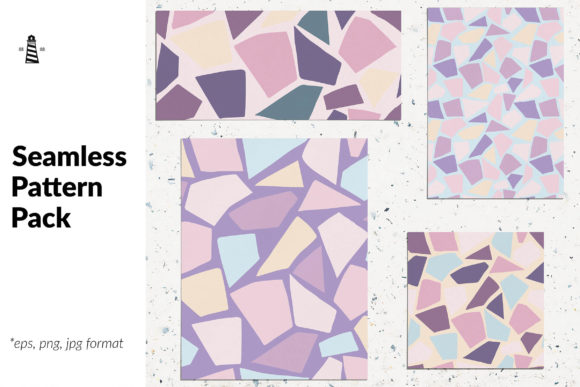
Pastel Mosaic Seamless Patterns: A Designer’s Toolkit for Refined, Scalable Surface Design
Seamless patterns are foundational in visual communication—serving as invisible scaffolding beneath branding, packaging, textiles, web interfaces, and educational materials. Among the many stylistic approaches available, Pastel Mosaic Seamless Patterns stand apart not through novelty alone, but through a rare convergence of hand-crafted precision, chromatic subtlety, and technical versatility. This collection isn’t assembled from algorithmic repetitions or stock templates; it is built from 100 original vector artworks—each carefully hand drawn, then rigorously refined to ensure flawless tiling across infinite dimensions.
What Makes These Patterns Distinctly “Hand-Drawn”?
The term “hand-drawn” is often diluted in digital design—used loosely to describe brush-stroke effects or stylized filters. In this context, however, it reflects a tangible workflow: each geometric shape—whether a softened hexagon, an offset rhombus, or a nested triangular tessellation—was first sketched with intention on paper or tablet, then translated into vector paths with deliberate anchor placement, consistent stroke weight, and balanced negative space. No auto-trace shortcuts. No generative smoothing. The slight asymmetries, the gentle variance in corner radii, the organic alignment of adjacent tiles—these are signatures of human judgment, not machine interpolation.
This attention to tactile authenticity directly impacts perception. Pastel tones—think desaturated mint, chalky rose, oat-milk beige, and misty lavender—are especially sensitive to rendering artifacts. A poorly constructed seamless repeat can introduce visible seams, color banding, or rhythm breaks that undermine the softness the palette intends to evoke. Because each of the 8 core patterns was built as a unified tile unit—not cropped or stitched post-creation—the transitions remain imperceptible even at large physical scales or high-zoom digital views.
Technical Composition: Why File Variety Matters in Practice
A robust pattern library must serve divergent production pipelines—and this set delivers with surgical specificity. You receive:
- 8 EPS files: Industry-standard, resolution-independent vector formats ideal for print workflows in Adobe Illustrator, CorelDRAW, or Affinity Designer. EPS retains full editability of paths, swatches, and layers—critical when adapting a pattern to match a brand’s exact CMYK profile or adjusting tile size without rasterization.
- 8 AI files: Native Illustrator documents with organized layers, named swatches, and non-destructive global colors. Designers can instantly recolor entire patterns using the Recolor Artwork tool or isolate individual mosaic elements for custom modifications—say, replacing one pastel tone with a client’s Pantone while preserving all spatial relationships.
- 8 PNG files (transparent background, 12 × 12 inches, 300 dpi): Optimized for digital mockups, UI overlays, or layered compositing in Photoshop or Figma. The transparency allows seamless integration over photographs, gradients, or textured backgrounds—essential for product packaging previews or social media banners where context matters as much as pattern.
- 8 JPG files (12 × 12 inches, 300 dpi): High-fidelity raster versions for presentations, client PDFs, or platforms that don’t support vector embedding. Unlike compressed web JPEGs, these retain full print-grade fidelity—no pixelation, no halos, no unintended dithering in light pastel zones.
This multi-format strategy eliminates common bottlenecks. An educator preparing classroom handouts doesn’t need vector editing skills—they use the JPGs. A textile developer sourcing for jacquard weaving imports the EPS into CAD software. A web designer building a CSS background uses the PNG’s transparency to layer over responsive gradients. The same underlying geometry serves each use case—without compromise.
Brand Identity & Packaging
Pastel palettes signal approachability, calm, and thoughtful curation—qualities increasingly sought after in wellness, education tech, sustainable goods, and boutique services. A cosmetics brand launching a refillable skincare line might apply one of the mosaic patterns as a subtle embossed texture on matte-finish cartons. Because the repeat is mathematically precise and dimensionally stable (12 × 12 inches at 300 dpi), it scales cleanly from business cards to shipping boxes without distortion or visible tiling artifacts. The geometric structure adds quiet sophistication—more intentional than a generic watercolor wash, less rigid than a grid-based dot pattern.
Digital Interfaces & Learning Tools
In e-learning platforms or children’s apps, visual clutter impedes comprehension. These patterns function as low-contrast, non-distracting backgrounds behind interactive elements. Unlike photographic textures or busy illustrations, the Pastel Mosaic Seamless Patterns provide just enough surface interest to define zones—say, distinguishing a quiz section from a reflection prompt—without competing for attention. Their soft edges and uniform value distribution reduce eye fatigue during extended screen time, aligning with WCAG contrast recommendations for background elements.
Architectural Visualization & Interior Mockups
Interior designers use seamless patterns to visualize wallcoverings, upholstery, or acoustic paneling in 3D renders. The 12-inch square dimension matches standard material sampling conventions, making it easy to map onto Revit or SketchUp surfaces at true-to-life scale. One designer recently applied a staggered diamond variant to simulate a custom ceramic tile installation in a pediatric clinic—its gentle geometry and muted tones created a soothing, non-clinical atmosphere while maintaining visual cohesion across walls, ceilings, and built-in cabinetry.
Educational Materials & Research Presentations
Researchers presenting data on cognitive load or environmental psychology have used these patterns as thematic backdrops for conference posters. The consistency of form—repetition without monotony—mirrors concepts like neural patterning or ecological succession. A biology educator printed a tessellated triangle variant onto laminated sorting cards for a lesson on symmetry in nature; students physically rotated and aligned the cards to explore rotational vs. reflective tiling—turning abstract geometry into tactile inquiry.
Design Considerations Beyond Aesthetics
Adopting any pattern library invites practical scrutiny. With Pastel Mosaic Seamless Patterns, three considerations consistently arise among experienced users:
- Color Adaptability: While the base palette is intentionally restrained, the vector foundation allows effortless hue-shifting. Designers report success shifting the entire set toward warmer undertones (e.g., peach + sage) or cooler variants (slate + seafoam) without breaking harmony—because saturation and luminance were calibrated relative to one another, not in isolation.
- Scale Sensitivity: Pastel geometries can appear washed out if scaled too small or overly dense if enlarged without adjustment. The 12 × 12 inch dimension provides a reliable anchor point: at 50% scale, it reads as delicate micro-pattern; at 200%, individual shapes become legible design motifs. Users note that scaling beyond 300% benefits from minor stroke-weight tweaks—a quick adjustment possible only because paths remain fully editable in AI/EPS.
- Contextual Contrast: These patterns thrive when paired with strong typographic hierarchy or bold singular imagery. They are rarely the focal point—but they elevate everything around them. A monochrome photograph gains warmth against a misty lilac mosaic; a minimalist sans-serif headline gains groundedness over a softly gridded backdrop. Their strength lies in service, not spectacle.
Why “Seamless” Is More Than a Buzzword Here
True seamlessness isn’t just about invisible joins—it’s about behavioral reliability. When a pattern is described as “seamless,” users expect it to behave predictably across tools, outputs, and scales. These files meet that expectation through construction discipline: each tile’s bounding box aligns precisely with its repeat origin; no stray points extend beyond the artboard; all clipping masks and transparency groups resolve cleanly upon export. That reliability translates directly to time saved—no troubleshooting misaligned tiles in print proofs, no re-exporting assets for different output devices, no last-minute fixes before a client presentation.
For creators who treat pattern design as infrastructure rather than decoration, this level of technical integrity is non-negotiable. It transforms what could be a decorative flourish into a reusable, dependable component—akin to a well-engineered typeface or a thoughtfully documented design system.
Who Benefits Most—and How They Use It Differently
A freelance illustrator might extract individual mosaic units to build custom borders or frame illustrations. A university communications team uses the PNGs to unify email newsletters, slide decks, and event signage under a cohesive visual language. A craft entrepreneur imports the AI files into Cricut Design Space to cut precise pastel-toned vinyl decals for nursery walls. A UX researcher embeds a low-opacity version behind survey questions to reduce perceived form length—leveraging perceptual psychology, not just aesthetics.
What unites these varied applications is not a shared industry, but a shared need: clarity without coldness, structure without rigidity, refinement without pretension. The Pastel Mosaic Seamless Patterns deliver that balance—not as a trend, but as a quietly capable tool, built to endure shifts in platform, audience, and purpose.